

Parent Guide · Heritage Families
Beyond “Kitchen Chinese”
Your child understands Grandma, giggles at the right moments, and then answers in English. Here is why that happens, and how to turn it into real reading, speaking and pride.
By the Motherly Notes teaching team · 8 min read
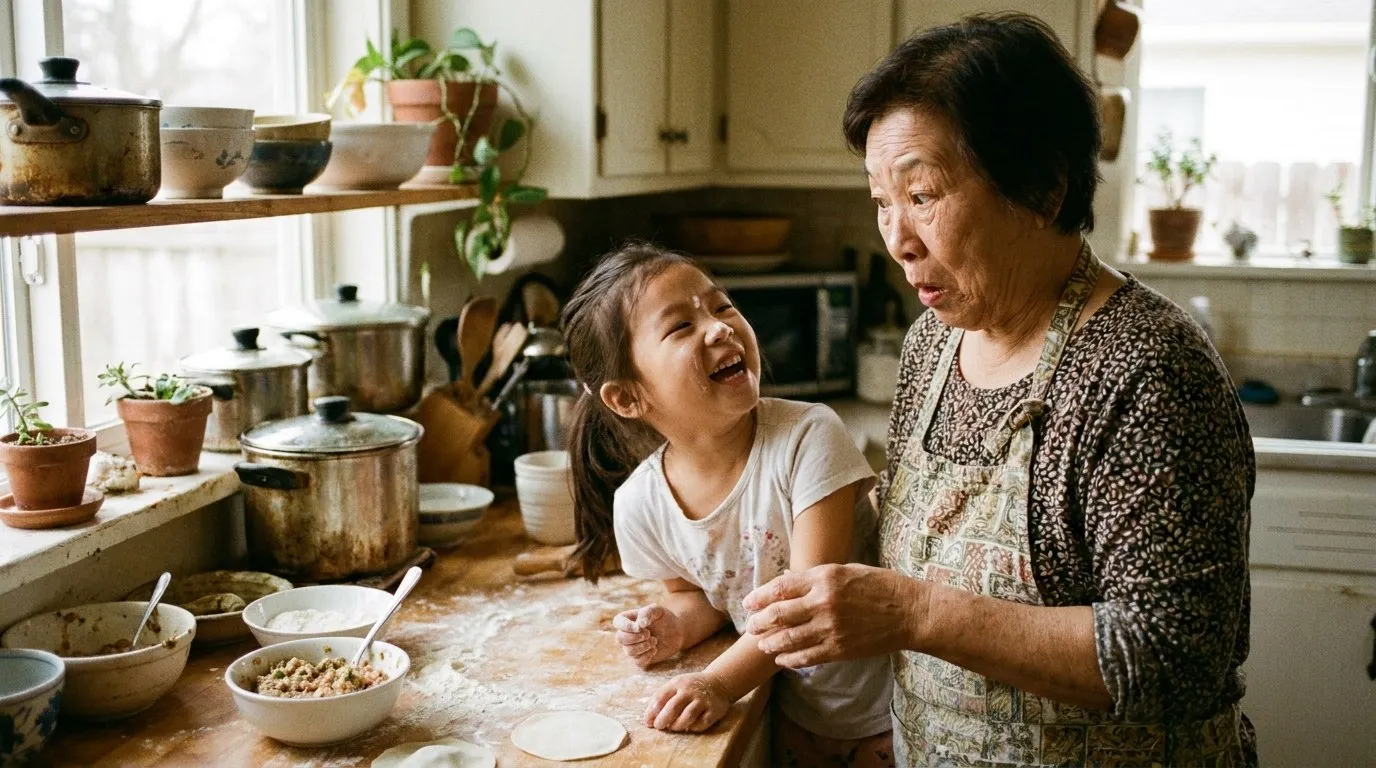
“Kitchen Chinese” is the language of home: 吃飯了, 快點, 好燙. It is warm, real and worth protecting. But it lives in a small room. It covers food, bedtime and being scolded for leaving shoes in the hallway. Ask a kitchen-Chinese kid about a science project or a favorite book, and the words run out.
That is not a failure. It is simply what happens when a language is only used for chores. The fix isn't more drills. It is giving Chinese a bigger house to live in.
Four signs your child is stuck in the kitchen
- They understand almost everything Grandma says, then answer in English.
- They can order dumplings, but can't tell you about their day.
- Reading stops at their own name and 大, 小, 人.
- Chinese school feels like a weekly chore, so the words fade by Monday.
Why understanding isn't the same as speaking
Listening and speaking are different muscles. Heritage kids hear thousands of hours of Chinese, so comprehension grows on its own. Speaking needs something else: a reason to talk, people their own age, and a place where mistakes are funny instead of embarrassing. Reading needs a third thing: steady, organized exposure to characters, so 3,000 “random drawings” start to look like the logical system they are.
“Kids don't talk because they're told to. They talk because they have something they're dying to say.”
Give Chinese a bigger house
The families who break through usually do one thing: they let Chinese carry subjects kids already love. Math puzzles. STEAM builds. Comics. Debate. When a child argues in Chinese about whether a dumpling is a sandwich, they reach for words no flashcard ever gave them.
That is how our classes are built. Kids are grouped by ability, not age, on a native Taiwan/China curriculum scale, then taught live in small, lively groups. Every lesson is recorded, so a missed week never means falling behind.

Practice between classes that actually makes kids think
Screen time worries every parent, and it should. Most language apps are tap-the-right-picture. Our learning worlds are puzzles first: kids can only move forward by reading Chinese correctly, and each game stretches a different thinking skill.
- Rotating pipes
- Kids turn pipe pieces in their heads and plan a full path before water flows: visual-spatial reasoning and planning.
- The slingshot bazaar
- Angle, force and moving targets: physics learned by trial and error, with every shot earned by reading correctly.
- The banquet train
- Remembering a five-dish order while the conveyor moves trains working memory.
- Look-alike chases
- Spotting 形近字 and 同音字 under gentle time pressure builds attention and self-control.
- Team challenges
- Partners split the work and plan out loud, so Chinese becomes something kids use together.
Words follow your child's level, and every higher level keeps reviewing the words from the levels below, so nothing learned is ever lost.
Three things to try this week
- Pick one dinner a week where questions must be asked in Chinese, even badly. Laugh at the bad ones together.
- Ask Grandma to tell one story from when she was your child's age. Let your child retell it back.
- Find out your child's real reading level. It is usually different from what parents guess.
Not sure where your child stands?
Our free Find My Level check points you to the right class. Or try one live trial class for $20.